
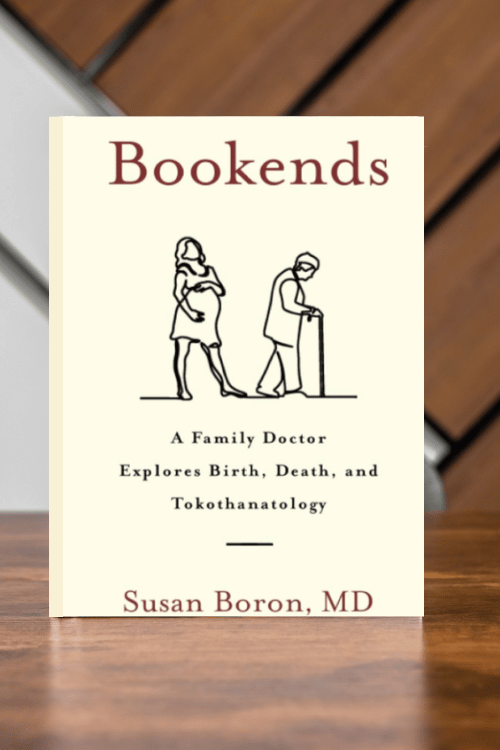
Toko●thanat●ology (n): The theoretical study of the parallels between birth and death, especially in medical care.
What do birth and death have in common? They both represent times of profound change, when patients and their families need emotional support and empathy from their caregivers—things they don’t teach in medical school.
The practical skills and knowledge required to provide care in obstetrics and palliative care are essential. But dealing with the deeper meaning, the human connection, is equally important. The very nature of these events encourages the caregiver to walk alongside the patient, to assist rather than control.

Why I Am The One To Write This Book
I practiced medicine in rural Ontario for over 40 years, and had a special interest in the care I was involved with in both ends of life. Influenced by my my parents who worked and taught about prepared childbirth and family centred maternity care, by my husband, Doug Boron who started as a palliative care volunteer and then developed a comprehensive palliative care program in our small community, by my patients’ journeys, and by my own life experiences, I realized that the principles of care we provide for pregnancy, childbirth, labour and delivery are mirrored in end-of-life care and palliative care.

A History of Obstetrics and Palliative Care
As a family doctor, I’ve witnessed how birth and death—our most profound life events—are shaped by the care we receive. In developed countries, maternity care moved from homes to hospitals in the 20th century, prioritizing safety but often sidelining the personal and emotional aspects of childbirth. Today, many are seeking more holistic, respectful approaches. Palliative care followed a similar path: death was once an event that usually happened at home, surrounded by loved ones. Medical intervention brought care to hospitals and ICU’s. The Hospice/palliative care movement sought to reintroduce these same personal and aspects to the process. This chapter includes a “history” of Tokothanatology. I would like to see this as a means of sharing the concepts of both of these practices enhances the experience for caregiver and recipient.

Principles of Family Centred Maternity Care and Palliative Care
In this chapter I look at the core principles of family-centred care—listening, inclusion, choice, and compassion—in both birth and end-of-life experiences. Drawing on clinical experience and patient stories, I present a Bill of Rights for maternity patients and a Bill of Rights for palliative care, affirming what every person deserves in these defining moments. I’ve come to see that the way we care for people at the beginning and end of life speaks volumes about our values. Both maternity and palliative care are most effective when grounded in respect, dignity, and the needs of the individual as well as the people around them.

Psychological, Spiritual and Socioeconomic Aspect for Childbirth and Death
Birth and death are not just medical events—they are deeply human experiences shaped by emotion, belief, culture, and connection. In this chapter, I reflect on how these life transitions impact individuals and families beyond the physical. Drawing from real clinical encounters, the chapter explores how hope, fear, grief, faith, and love surface at both the beginning and end of life. I hope you will gain insight into the doctor’s role in supporting not only the body, but also the mind and spirit, honoring the whole person in moments of profound change.
Rituals around Birth and Death
Birth and death are two of life’s most transformative moments—and both leave families forever changed. Across cultures and generations, rituals have provided a framework for navigating these seismic shifts, offering comfort, meaning, and connection. I discuss how these practices help people move through the chaos with a sense of direction—whether joyful or sorrowful. In this chapter, we explore how rituals shape the way we welcome new life and grieve loss in many different communities. Understanding and honoring these traditions is not just respectful—it’s essential to truly caring for patients and families in their most vulnerable moments.

Portrayals of Birth and Death
There are so many meaningful ideas I have learned from fiction, movies, art and television. Humans have always told stories about birth and death—our most universal experiences. Throughout history and into the present day, our expectations about birth and dying are influenced by literature, media, art, and even offhand jokes — both for patients and their caregivers. Stories evoke emotions, hope, fear and often misunderstanding about real life situations. By examining examples of these portrayals, I hope you will see how we all come to see how we understand life’s beginnings and endings, often more than we realize. Reflecting on these influences, we can better recognize and address the gap between fiction and reality, and offer care that is grounded, compassionate, and clear-eyed.

Pain and Other Symptoms, or “It Hurts!”
Pain is one of the most feared parts of both childbirth and dying. In this chapter I don’t offer clinical protocols, but rather practical, compassionate ways to help ease suffering at both ends of life. Pain is never just physical—it’s shaped by fear, past experiences, and meaning. As caregivers, our role includes reframing, educating, and supporting people through what can feel overwhelming. Whether helping a woman through labour or guiding a patient at the end of life, there are powerful, non-drug tools we can offer to bring comfort and reassurance.
We also review common treatment ideas for other distressing symptoms at both ends of life.

Ethical and Legal Issues Around Birth and Death
This chapter explores ethically challenging real-life cases encountered by a family doctor. Scenarios include some of my true-life stories from my practice: a pregnant teen seeking escape, an elderly man requesting assisted death, a young girl wanting birth control against parental wishes, and a cancer patient refusing surgery amid family conflict. These vignettes illustrate the complex moral, legal, and emotional dilemmas faced in medical practice, emphasizing how personal values, family dynamics, and patient autonomy intersect with professional responsibility at both the beginning and end of life. I also delve into the history and current status of MAiD and abortion as of the time of writing in 2022.

And Suddenly…..
From sudden death to unexpected complications in birth, in this chapter I discuss how compassionate, steady care can guide families through profound grief and crisis. Through real-life stories, I examine how we can balance medical decisions with empathy, offering insight into navigating shock, sorrow, and uncertainty. The universal importance of being present, of listening and of understanding the real differences people feel when events are sudden or unexpected. Grounded in both general maternity and palliative principles, we can bring meaning and healing when life takes an unforeseen turn.

This chapter is a summary of the many lessons I have learned in my years in practice, especially in the field of Tokothanatology. The importance of communication- at all levels. The value of primary care and longitudinal care. The importance of self care for the caregiver. The recognition that there must be balance between hard science, intuition, and emotion. And that there is joy and privilege in the ability to share and care with other human beings.
Reader Reviews
This is a unique and engaging guide for anyone who is concerned with the physical, mental, and social well-being of new parents, infants, people at the end of their lives, and all the people surrounding them. I’m sure it will be on reading lists for both the toko- and the thana- ends of the spectrum of care.
Carl von Baeyer, Psychologist
“As a doula and acupuncturist working in maternity care, I found this book incredibly refreshing. Dr Boron’s genuine interest and care for her patients and the way the system supports families and communities at birth and death is highlighted in her many stories. She offers us a concise and easy to read history of maternity and palliative care and looks at the many different ways death and birth are honoured and ritualized throughout the world. I highly recommend this book to anyone who is interested in birth, death and how we care for each other in these passages.”
Eva Bild doula educator, Victoria BC
“This wonderful book explores and compares the processes and medical conventions of birth and death. As someone who witnessed huge changes in the medical model for labour and delivery in the 70s, and is now looking the other end of life, I was inspired by the insights, experiences, and shared wisdom. The warmth and compassion shines through in this very informative and thoughtfully written book. Engaging anecdotes, historical and cultural references make it an easy read. Highly recommended.”
Mona Duffy, retired teacher, Ontario
“At once both personal and professional, this is an engaging exploration of the similarities between supporting people in birth and in death. The author sensitively balances her own experiences as a family physician with practical ways to help people navigate these intimate passages. Although written for family physicians, this excellent book has much to offer anyone working in these fields. Indeed it will resonate for anyone navigating these passages.”
Lori Messer, childbirth educator and hospice coordinator